Is Your Control System Keeping Up With Your Operation?
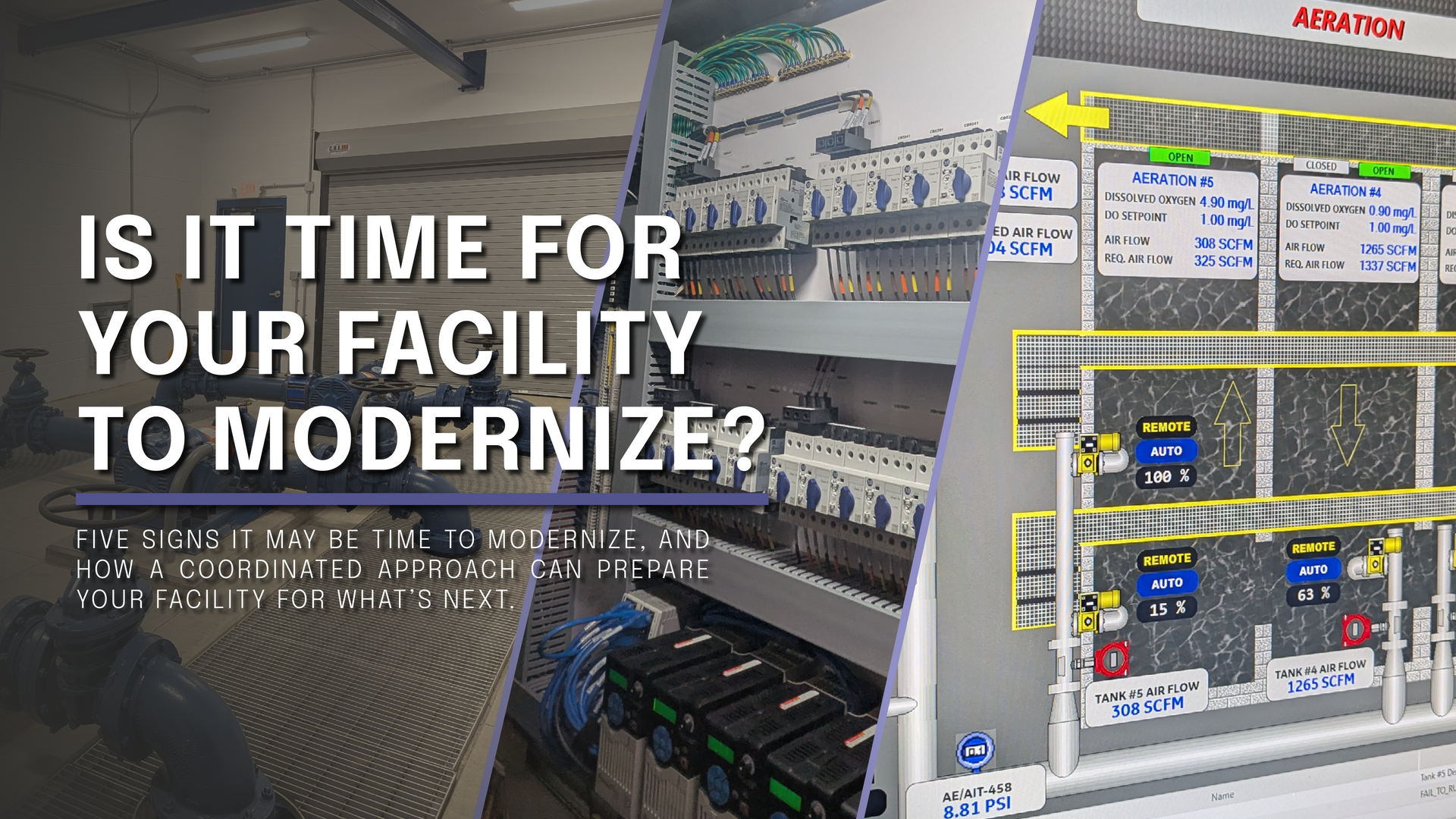
Five signs it may be time to modernize, and how a coordinated approach can prepare your facility for what’s next.
Your operation probably doesn’t look exactly like it did when your control system was installed.
Equipment gets added. Processes change. Production demands increase. Facilities expand. Operators need access to more information. And over time, new technology gets layered into systems that were designed for a different set of needs.
The result? A control system can be running—and still be holding the operation back.
Modernization doesn’t have to mean replacing everything. It means recognizing where existing controls are creating limitations and developing a practical plan to move forward.
Here are five signs it may be time to start that conversation.
1. New Equipment Is Getting Harder to Integrate
Adding a new pump, VFD, valve, instrument, treatment system or piece of production equipment shouldn’t create a new island of automation.
But integrating modern equipment into older controls can become increasingly complicated. Different communication protocols, limited PLC capacity and legacy hardware can turn what should be an improvement into an integration challenge.
A modernization plan looks beyond the new equipment itself. It considers how controls, instrumentation, electrical systems and communications need to work together so new investments become part of the larger operation.
2. Operators Don’t Have the Visibility They Need
More data isn’t necessarily better. Better access to the right information is.
Operators and maintenance teams need to understand what equipment is doing, recognize problems and respond quickly. Managers and other decision-makers may need a broader view of system performance.
That could mean improving an HMI, expanding SCADA capabilities or providing secure remote access to operational information. In distributed environments, it may mean giving operators visibility into pump stations, lift stations, tanks or other remote assets without requiring a trip to the site just to understand what’s happening.
A successful control system isn’t simply one where the programming works. It’s one that helps the people running the operation use information effectively.
3. Your Communications Infrastructure Is Becoming a Bottleneck
Control systems have changed dramatically, but many facilities still rely on a combination of older serial connections, radio networks and newer communications technologies.
That can make it harder to connect equipment, share information and expand the system.
Migrating appropriate portions of the network to Ethernet, fiber or other modern communications infrastructure can improve connectivity while creating a stronger foundation for future controls, SCADA and remote-monitoring improvements.
The key is viewing communications as part of the overall modernization strategy—not as a separate technology project.
4. Obsolete Controls Are Limiting Your Options
An older PLC doesn’t need to be replaced simply because it has a few years behind it.
But when obsolete hardware becomes difficult to support, replacement parts are scarce, or an existing platform can no longer accommodate planned improvements, it can begin limiting the operation.
Migrating legacy PLCs to current Allen-Bradley or other modern platforms can address those limitations while creating opportunities to improve programming, diagnostics, communications and integration.
And it doesn’t necessarily have to happen everywhere at once. A well-planned migration can prioritize the systems creating the greatest constraints while accounting for future phases.
5. Every Improvement Is Becoming Its Own Project
This may be the biggest sign that it’s time to think differently.
A new control panel here. A PLC upgrade there. New instrumentation on another project. SCADA improvements somewhere else.
Each project may solve an immediate need, but without a broader plan, facilities can end up with another generation of disconnected systems.
Effective modernization considers the complete control environment: electrical and mechanical design, control panels, PLC programming, HMI and SCADA development, instrumentation, communications, equipment integration, startup and commissioning.
The goal isn’t to buy more engineering services.
It’s to make all of those disciplines work together to solve the operational problem.
Modernize With the Next Move in Mind
The best time to think about controls modernization isn’t necessarily when something fails.
It’s when the existing system starts making the next improvement harder than it should be.
At Seifert Engineering, we help customers understand where their current systems are creating limitations and develop coordinated modernization solutions around how their facilities actually operate. That includes looking beyond the programming itself to the equipment, electrical systems, communications, operator experience and future improvements that all need to work together.
Modernization isn’t about chasing the newest technology. It’s about making sure your control system is ready for what your operation needs next.
Bring Us Your Challenge at One Water
These issues affect facilities across many manufacturing and process industries, but they’re especially familiar in water and wastewater, where treatment plants, pump stations, lift stations, tanks and other critical assets must work together reliably.
Seifert Engineering will be at the One Water Technical Conference on August 18–19. The show is in Cincinnati, OH and details can be found at https://www.onewaterohio.org/.
If you’re attending, stop by Booth #466 and tell us what you’re trying to improve—whether that’s replacing obsolete controls, integrating new equipment, improving SCADA visibility, connecting remote assets or developing a broader modernization plan.
Bring us the problem. Let’s talk about the solution.
Why Seifert?
Seifert Engineering combines hands-on industry experience with a practical, operator-focused approach to controls modernization.
We take the time to understand how operators and maintenance teams actually use the system, then develop PLC programs, HMI screens, controls, and electrical solutions that are intuitive, reliable, and easier to operate and troubleshoot.
Based in Massillon, Ohio, our team supports municipalities and facilities throughout Ohio and the surrounding regions with integrated controls, electrical engineering, and system modernization solutions.
Frequently Asked Questions About Control System Modernization
What is control system modernization?
Control system modernization is the process of upgrading aging or obsolete controls while improving how equipment, communications and operational data work together. A modernization project may include PLCs, HMIs, SCADA systems, VFDs, instrumentation, control panels, communications infrastructure and other integrated equipment.
How do I know when it’s time to modernize a control system?
Common signs include obsolete or difficult-to-support hardware, limited system visibility, communications issues, difficulty integrating new equipment, and existing controls that restrict future improvements. Modernization planning can help identify which limitations should be addressed first.
Do I have to replace my entire control system at once?
Not necessarily. Control systems can often be modernized in phases based on equipment condition, operational priorities, available shutdown windows and future plans. A coordinated approach helps ensure each phase supports the larger modernization strategy.
Can new equipment be integrated with an existing control system?
In many applications, yes. New pumps, VFDs, valves, instrumentation, treatment equipment and production machinery may be integrated with existing controls. The appropriate approach depends on the existing hardware, communications infrastructure and system requirements.
How can SCADA improve plant operations?
SCADA systems can provide operators and other decision-makers with greater visibility into equipment status, alarms, trends and process conditions. They can also support monitoring of distributed assets such as pump stations, lift stations and tanks.
Why use one engineering partner for a control system modernization project?
Control system modernization often involves multiple interconnected disciplines, including electrical design, controls, programming, instrumentation, communications and systems integration. Working with one engineering partner can help coordinate those pieces as part of a complete solution from planning through startup and commissioning.